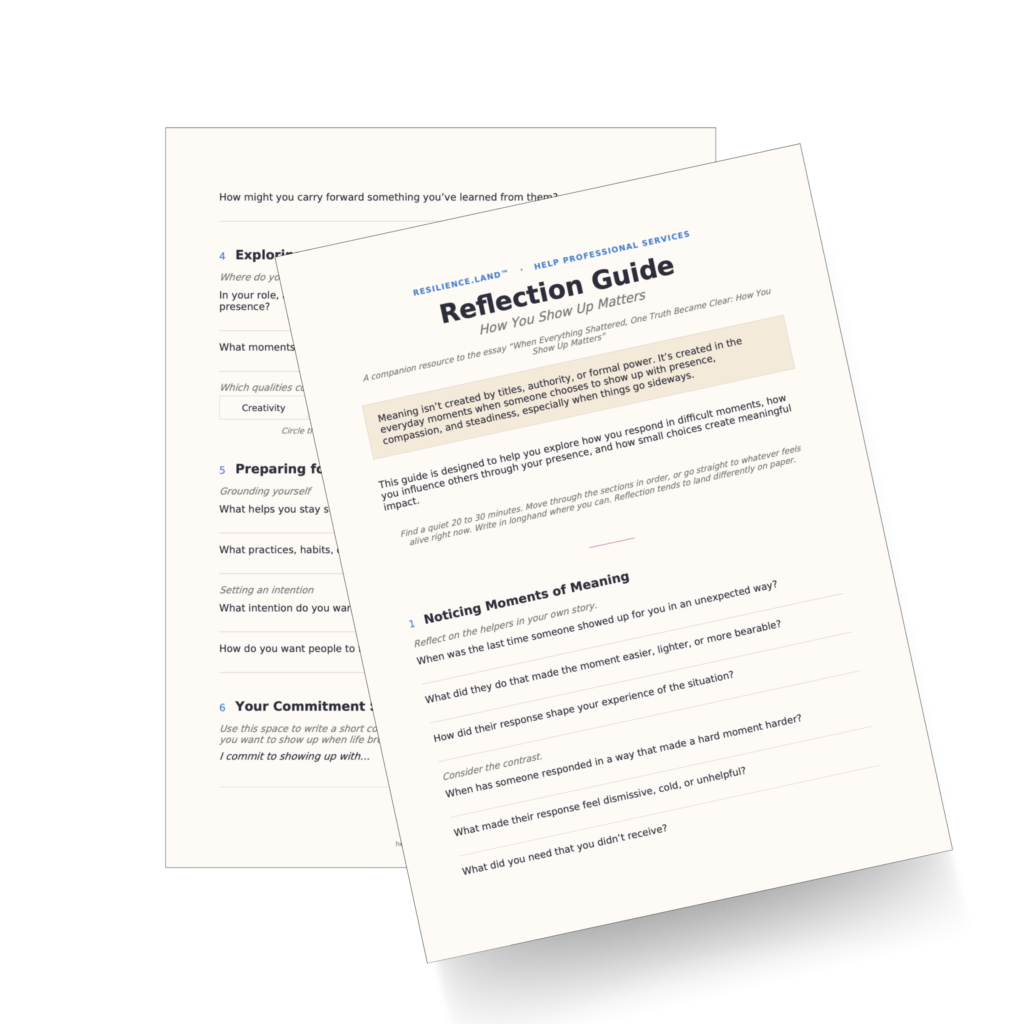
Meaning isn’t something reserved for people with impressive titles or corner offices. It’s created in the everyday moments — the ones that catch us off guard, test our patience, and reveal who we really are.
And sometimes, meaning shows up most clearly when life breaks open. In my case, it happened quite literally.
The Morning That Went Sideways
My daughter and I were on the East Coast visiting graduate schools — a trip filled with anticipation, plans, and tight schedules. We were minutes from leaving the hotel we’d only checked into the night before when a nine‑story window shattered during installation. Thick tempered glass rained down on the workers below… and onto my dad’s car, which I had borrowed for the trip.
I tried to run out and move the car, but glass was falling like hail. When the workers finally radioed that it was safe, we grabbed our luggage, loaded up, shut the hatch — and watched the back window shatter into a thousand pieces. We stood there stunned. A city we barely knew. A car we didn’t own. A schedule we couldn’t keep. And no idea what to do next.
Where Meaning Shows Up: In the People Who Choose to Care
What happened next taught me something I’ll never forget: meaningful impact often comes from people who show up, stay present, and do what they can — even without official authority or obligation. The hotel manager didn’t cause the accident. It wasn’t his responsibility. But he chose to help anyway. He offered valet parking for the damaged car, a comfortable place to regroup, refreshments, and genuine concern. He didn’t fix the problem, but he made the moment bearable.
The small glass company owner was overwhelmed, tending to injured workers and a worksite covered in broken glass. His first reaction wasn’t reassuring — but he came back with humility, an apology, and the building manager’s contact information.
The building manager was juggling multiple crises. His initial assessment: no way the car could be repaired before Tuesday. I remained determined to find a solution and get back on the road that day, since we still had two states to reach before returning the car and flying home. Still, he committed to covering the damage and answering my calls.
Then came the long, relentless hours of searching, calling, and problem‑solving. Finally, a small shop 10 minutes away agreed to seal the back window with plastic and inspect the front so we could continue our trip. They didn’t have to squeeze us into an already full day — yet they did.
We reached my dad’s, flew home as scheduled, and I kept managing the repair from home. And over the next three weeks, across multiple states and countless follow‑ups, a few people stayed with me until the very end. They weren’t the ones “in charge.” They weren’t the ones who caused the problem. But they chose to make a difference.
Those individuals brought meaning into the world through their work — and it mattered deeply in mine.
The Quiet Heroes We Forget to Notice
Not everyone responded that way. Some passed the buck. Some hid behind “there’s nothing I can do.” Some simply didn’t see the human being in front of them.
But the ones who did? They stood out.
They reminded me of other frontline heroes I’ve encountered:
- The pediatric nurse who gently welcomed my newborn son back into the hospital the night he was discharged.
- The overwhelmed airline gate worker who softened instantly when met with genuine kindness.
- The front desk staff, operators, schedulers, store clerks who choose compassion over convenience.
And yes, there are moments that still sting — like the police officer who wrote me a ticket the week after my firstborn son died, unmoved by my tears. Just doing his job.
These experiences — the beautiful ones and the painful ones — all point to the same truth:
You Matter. Your Work Matters. Your Choices Matter.
No matter where you are in a company, a community, or a family, you matter. Your role matters. Your presence matters. Your response matters.
You may not have final decision‑making power, but you have something just as important:
Creativity. Compassion. Patience. Perseverance. Presence.
You can choose to respond in a way that makes someone’s world a little lighter, a little easier, a little more hopeful.
And the next time things don’t go according to plan — for you or for someone standing in front of you — you get to decide what kind of meaning you bring into the moment.
Simple Practices to Make Everyday More Meaningful
Here are seven simple practices to carry with you.
1. Ask yourself daily.
How do I want people to feel after interacting with me? What would I appreciate if I were in their situation?
2. Practice micro compassion.
Small actions make a big difference. A warm greeting. Eye contact. A moment of patience. A sincere “I’m sorry this is happening.” A willingness to look for one possible solution.
3. Know your sphere of influence.
You don’t need authority to make an impact. You only need intention.
4. Respond, don’t react.
When things go wrong: pause, breathe, and choose the response you’ll be proud of later.
5. Remember the invisible stories.
Everyone carries something you cannot see. Treat them accordingly.
6. Celebrate your wins.
At the end of each day, ask: Where did I make someone’s day easier? Where did I show up with kindness? Where did I choose meaning over frustration?
7. Commit to being the person who helps.
Even when you can’t fix everything, you can still make someone feel seen.
That is finding meaning at work in its most honest and human form. Not a title. Not a performance review. Just one person choosing to show up for another.
And that changes everything.
Angela Scaperlanda Bujan is the founder of Resilience Land and Help Professional Services. She works with individuals, teams, and organizations to build personal and organizational resilience from the inside out. To learn more or to connect, visit www.helpps.org.